
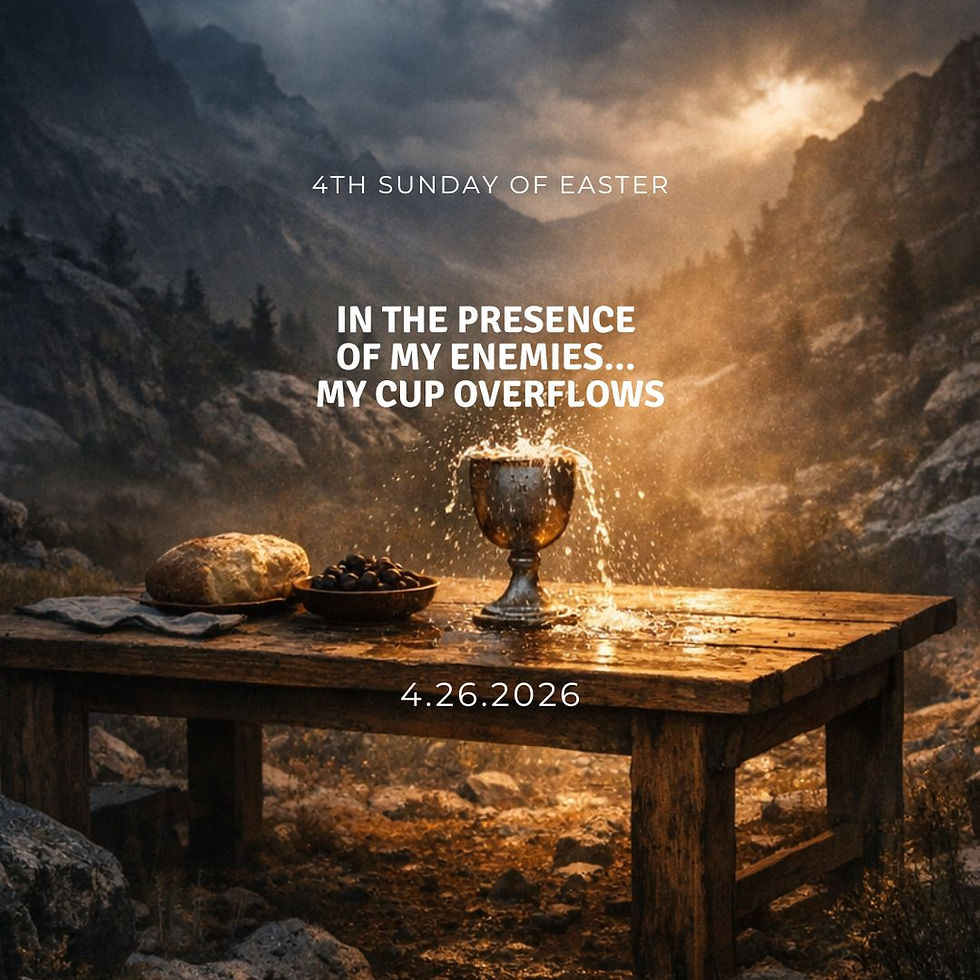
In the Presence of My Enemies… My Cup Overflows
- yikigai2021

- Apr 25
- 4 min read
4.26.2026
4th Sunday of Easter
[Texts] Acts 2:42–47 ⠂Psalm 23 ⠂ 1 Peter 2:19–25 ⠂ John 10:1-10
Dear Church, the People of Resurrection,
Easter blessings to you and to our beloved online worshippers.
Psalm 23 is the prayer so many of us know by heart.
The Lord is my shepherd.
He is all that I need.
He restores my soul.
But the line that stops me every time is this:
“In the presence of my enemies… my cup overflows.”
The psalm doesn’t pretend enemies disappear.
And we shouldn’t pretend that either.
Yet notice what the psalmist does:
He keeps his eyes on the Shepherd, the table, the overflowing cup.
He remembers and declares that goodness and mercy pursue God’s people, because he has seen it in the life of the community, past and present.
So it raises a question for us:
What if the real threat is not what stands against us,
but what pulls our attention away from the Shepherd who stands with us?
Distractions come and go, and sometimes we find our way back quickly.
But when distractions become the center of our lives, when they become the loudest voice, that’s when we start saying things like, “That’s just life. Nothing can be done.”
As Jesus teaches in Matthew 19, Mark 10, and Luke 18, God can do what humans cannot, which brings us to the deeper question:
What if the real spiritual danger is what we choose to center?
What if the distractions aren’t just noise but the very things that pull our attention away from the Shepherd, the table, the overflowing cup?
A few weeks ago, I mentioned Jesus’ interpretation of death as separation from God and how he told the disciples that Lazarus wasn’t dead but had fallen asleep, and how life is restored when we are re‑connected to God.
That reminder came back to me when I heard a story from Taipei’s mayor at the International Mayors’ Forum last month.
He described an American tourist who had a heart attack while hiking Elephant Mountain in Taiwan. The city’s AI‑supported emergency system sent his vital signs ahead in real time while he was in the ambulance, so the hospital could prepare before he even arrived. That preparation saved his life.
The mayor said, “AI, in Taipei, is not just technology; it’s an extension of our way of caring. It checks on you before you even know you need help.”
And when I heard that, I thought:
That is exactly how God’s goodness and mercy pursue us.
That is exactly what a Good Shepherd is like.
Before we sense danger, God is already moving.
Before we know what we need, God is already preparing the way.
Before we can name our fear, God is already gathering what will save us.
God’s goodness arrives before we know we need it.
God checks on us before we know to check on ourselves.
Just as that system saw what the tourist could not see,
God sees what we cannot see.
God responds before we know to call.
God prepares what we need before we know to ask.
And to be clear, AI is only a tool. It cannot replace God or resemble God.
But this story can help us imagine what the psalmist is proclaiming:
a Shepherd whose goodness and mercy move toward us
long before we know to reach back.
God sees what we cannot see.
God responds before we know to call.
God prepares what we need before we know to ask.
Most of us have lived moments when help arrived before we knew how to ask for it.
Jesus names the opposite reality too: thieves that steal our attention and diminish our souls. But when we know his voice, our Shepherd, the one who calls us by name, our cup overflows as we follow him into life.
This same truth shows up in the Book of Acts.
In Acts 2, the early believers are not living enemy‑free lives.
They are surrounded by uncertainty, pressure, and distraction.
They don’t know what comes next.
And yet they stay focused.
They keep sharing the Good News.
They watch God form a community where people share what they have, break bread, pray, and tend to one another’s lives.
Not because life is easy but because God’s goodness and mercy feel more real and tangible than their fear.
Their cup overflows, and God keeps drawing more people into their shared life.
Peter echoes this same hope. He writes to people who know suffering, misunderstanding, and hostility. He doesn’t promise that their enemies will disappear, but he declares something better: ‘You have returned to the shepherd and guardian of your souls.’
The Good Shepherd is not a shield that blocks all harm.
The Good Shepherd is a presence that carries us through harm without letting it define us.
Our enemies, our distractions, cannot name us, claim us, or shrink us.
So let me ask:
Where has the Shepherd shown up for you,
what has been distracting you,
or what has filled your cup?
And how will you celebrate the overflowing cup already set before you?
Psalm 23 teaches us something profound:
Enemies do not get the last word.
They do not get the center of the story.
They do not get the power to define our life.
The Shepherd does.
The Lord’s table does.
The overflowing cup does.
So what is the Good News today?
The Good News is not that enemies disappear.
The Good News is that God’s abundance is stronger than whatever stands against us.
The Good News is that our Shepherd is already with us
before we call, before we notice, before we know we need help.
The Good News is that our cup is already overflowing,
even if distractions still surround us.
Let us pray.
Dear Lord Jesus, our beloved Shepherd,
Your table is set. Your cup is overflowing.
We give thanks for your goodness and mercy pursuing us.
Give us eyes to see the table,
ears to hear you calling our names,
a resurrected life in you,
ready for us to notice,
to claim, to celebrate.
Amen.



Comments